
6 Essential Questions to Ask Before Hiring an In-Home Personal Trainer in Chicago
- Amanda Boike

- Dec 26, 2025
- 6 min read

By Amanda Boike Fitness The Highlights: Before hiring an in home personal trainer Chicago (2026), ask about credentials, screening, low-impact programming, intensity targets, progress tracking, and logistics. Expect $50–$150/hour for an in-home trainer in Chicago and plan to strength train 2–3 days/week for meaningful change over 8–12 weeks,. Use effort targets like RPE/RIR- not vibes.
Hiring an In Home Personal Trainer
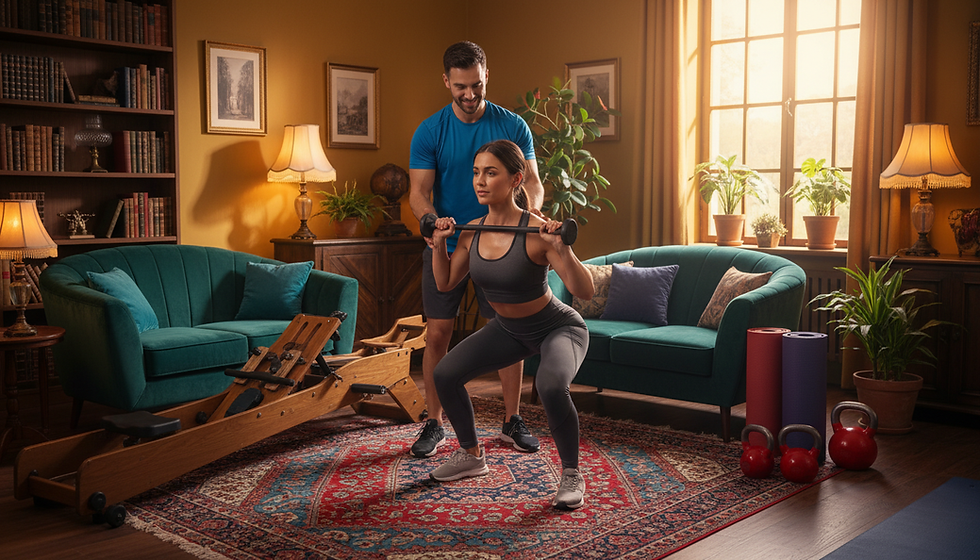
Hiring a trainer to come to your home can be the ultimate upgrade- especially if your calendar is chaos, the gym feels like a full-contact sport, or your joints are sending strongly worded emails.
But here’s the thing: in-home training is only as good as the coach and the plan. And the plan should absolutely include Low Impact Strength Exercises that feel joint-friendly without being a glorified stretch session.
Let’s make sure you’re hiring a pro who can get you strong, safely, in a real Chicago living room- whether you’re in Lakeview, Lincoln Park, or squeezing in sessions between meetings in the West Loop.
First, a quick “good program” reality check (so you can spot fluff)
A legit strength plan for busy women 35–60 usually hits these basics:
Frequency: Strength work at least 2 days/week (more like 2–3 for noticeable progress). (Source: CDC) CDC
Full-body coverage: Multiple major muscle groups across the week- not just “arms + abs forever.” (Source: AHA Scientific Statement) AHA Journals
Effort that’s trackable: Using RPE (rate of perceived exertion) and/or RIR (reps in reserve) so intensity isn’t guesswork. (Source: Sports Health systematic review) SAGE Journals
Progression: You gradually lift more, do more reps, slow the tempo, increase range, or reduce assistance over time. (Source: ACSM) ACSM
Here's the receipt, straight from the top:
“In addition, adults need at least 2 days of muscle-strengthening activity each week.” —CDC (Source: CDC) CDC
Alright. Now let’s get you the six questions that separate “great hire” from “why is this like a sweaty TikTok?”
1) “What are your credentials, and do you carry insurance + CPR/AED?”
This isn’t being intense. This is being smart.
Listen for:
A respected certification (ideally NCCA-accredited) and ongoing education
CPR/AED cert (non-negotiable)
Professional liability insurance
One quick credibility check you can use: ask if their certification is NCCA-accredited. For example, NASM explicitly notes its CPT program is NCCA-accredited. (Source: NASM) NASM
Green flag answer sounds like: “I’m certified through an NCCA-accredited program, CPR/AED certified, insured, and I do continuing ed in biomechanics / training women in peri/menopause”
Red flag answer sounds like: “I’ve been working out forever- same thing.” (Cool story. Not a credential.)
2) “How do you screen for safety before we start, especially if I have pain, dizziness, or past injuries?”
A good trainer doesn’t “diagnose”- they screen, adapt, and refer out when needed.
Ask what they use for screening. A widely used tool is PAR-Q+ (Physical Activity Readiness Questionnaire), which helps determine whether you should seek medical guidance before increasing activity. (Source: PAR-Q+ 2023) eParmedX
What you want:
A health history + movement/strength baseline
Clear rules for when they pause training and refer you out
A plan that starts conservatively and ramps with feedback
Pro tip: If you’ve had recent symptoms like fainting, chest discomfort, or unexplained balance issues, a responsible trainer will take that seriously and may request medical clearance. (Source: PAR-Q+ 2023) eParmedX
3) “Can you program Low Impact Strength Exercises that still build real strength?”
Low impact doesn’t mean low effort. It means low joint drama.
This is where biomechanics matters: choosing exercises that load muscles effectively while keeping joint stress reasonable, especially if you’ve got cranky knees, a sensitive low back, or you’re navigating peri/menopause.
Research in postmenopausal women shows resistance training can improve physical fitness and body composition outcomes (think: strength and lean mass changes), supporting why strength work is worth your time. (Source: Systematic review/meta-analysis) PubMed
Ask for examples based on your body:
Knee-friendly squat patterns (box squat, supported sit-to-stand, split squat variations)
Hip hinges without back irritation (kickstand RDL, elevated deadlift)
Shoulder-friendly pressing (landmine-style angles, floor press, tempo push-ups)
“Sneaky strong” options: carries, isometrics, slower eccentrics
Green flag: They can explain why an exercise is a fit for you- levers, joints, range of motion, tempo. (Source: ACSM) ACSM
Red flag: They only offer one intensity setting: “hardcore” or “baby weights.”
4) “How hard will sessions be, and how do you measure intensity without guessing?”
This is the question that upgrades your results.
Two tools you’ll hear from evidence-informed coaches:
RPE (Rate of Perceived Exertion)
A systematic review supports RPE as a practical tool for monitoring resistance training intensity relative to load and other variables. (Source: Sports Health systematic review) SAGE Journals
RIR (Reps In Reserve)
RIR helps estimate how many reps you had left before technical failure- useful for autoregulating intensity. (Source: Bastos et al., 2024) PMC
A realistic starting target (many clients love):
Most working sets around RPE 7–9 (roughly 1–3 reps in reserve) for strength-building
Some lighter “skill” sets earlier, especially when learning form
One nuance: RIR can be less accurate for true beginners at first- good coaches teach the scale and calibrate it over a few weeks. (Source: Bastos et al., 2024) PMC
5) “How will we track progress, and what does ‘success’ mean besides soreness?”
If the only progress metric is “I’m sweaty,” we need a new plan.
A good trainer tracks at least one strength metric, one capacity metric, and one real-life win.
Examples you can steal:
Strength: goblet squat load, row weight, carry weight, split squat depth
Capacity: total reps at a given load, density (same work in less time), steadier RPE
Real life: stairs feel easier, luggage is less annoying, fewer “random aches,” you feel stable getting up from the floor
And yes- consistency beats occasional hero sessions. ACSM notes many people meet aerobic guidelines, but fewer meet resistance-training recommendations- so adherence is a real differentiator. (Source: ACSM) ACSM
6) “What will this cost in Chicago, and how do logistics work in a real home?”
Let’s talk numbers (and the stuff that can quietly wreck your routine).
Typical pricing (Chicago)
In-home personal training: Ranges from $50–$150 per hour in Chicago.
Gym membership context: FFC lists dues commonly around $129–$159/month for single-club access, with higher tiers up to $239/month. (Source: FFC) Fitness Formula Clubs
Quick math (so you can budget like a boss):
2 sessions/week at ~$99/session ≈ $198/month
3 sessions/week at ~$99/session ≈ $297/month (Your actual quote will vary by session length, travel, experience, and package size.)
Logistics to clarify before you commit
Do they bring equipment (adjustable dumbbells, bands, bench, mats), or will you need basics?
Minimum space needed (many great sessions fit in an 8x8-ish area)
Travel fees by neighborhood / parking realities
Cancellation policy (because Chicago winters + life)
Communication between sessions (form checks? plan updates?)
Green flag: They make the plan sustainable for your schedule and your space- not just your motivation.
A “steal this” checklist for your consult call
If you only ask five follow-ups, make them these:
“What does my first 2-4 weeks look like?”
“How will you scale Low Impact Strength Exercises if my knees/shoulders are cranky?”
“How do you decide when I go heavier?” (listen for RPE/RIR or other tracking) SAGE Journals+1
“What do you track every session?”
“What’s your plan if I report pain, dizziness, or symptoms?” (listen for screening + referral) eParmedX
FAQ (quick answers)
How many days per week should I strength train after 40?
At least 2 days/week, and many people do best with 2–3 for progress. (Source: CDC) CDC
Are Low Impact Strength Exercises effective?
Yes—, f they’re programmed with progressive challenge. Resistance training is linked with meaningful benefits, including in midlife/postmenopausal populations. (Source: systematic review/meta-analysis) PubMed
What should an in-home assessment include?
Health history + readiness screening (often PAR-Q+), movement basics, and simple strength baselines- then a plan. (Source: PAR-Q+ 2023) eParmedX
What is RPE?
A perceived-exertion scale used to guide intensity; research supports it as a practical monitoring tool in resistance training. (Source: Sports Health systematic review) SAGE Journals
What is RIR?
An estimate of how many reps you had left before failure- useful for regulating intensity without max testing. (Source: Bastos et al., 2024) PMC
How much does an in-home personal trainer cost in Chicago in 2025?
A common range is $50–$150/hour depending on experience, session length, and packages.
If you want the “Amanda Boike Fitness” approach in your home
If you’re looking for an in home personal trainer Chicago who prioritizes physics-based strength, biomechanics-informed exercise choices, and consistency you can actually sustain- this is exactly the lane at Amanda Boike Fitness.
Think: joint-friendly strength, clear intensity targets, real progress tracking, and workouts that make daily life feel easier (stairs, travel days, carrying everything like a one-trip legend).
Sources (6–10)
CDC — Adult Physical Activity Guidelines (Source: CDC) CDC
ACSM — “Resistance Exercise for Health” (published June 6, 2024) (Source: ACSM) ACSM
American Heart Association — Resistance Exercise Training scientific statement (2024) (Source: AHA) AHA Journals
PAR-Q+ (Jan 2023) — Physical Activity Readiness Questionnaire for Everyone (Source: PAR-Q+) eParmedX
NASM — National Accreditation / NCCA-accredited CPT (Source: NASM) NASM
Bastos et al. — Repetitions-In-Reserve (RIR) scales review (2024) (Source: PMC) PMC
Petro et al. — Systematic review on RPE scales in resistance training (2024) (Source: Sports Health) SAGE Journals
González-Gálvez et al. — Systematic review/meta-analysis on resistance training in postmenopausal women (2024) (Source: PubMed) PubMed
Fitness Formula Clubs (FFC) — Membership dues ranges (Source: FFC) Fitness Formula Clubs


Comments